5 Things That Hurt Your Credit Score (and How to Fix Each One)
Introduction
Your credit score can influence your ability to qualify for credit cards, loans, housing, and other financial opportunities. Understanding what affects your score is an important step toward building a healthier credit profile.
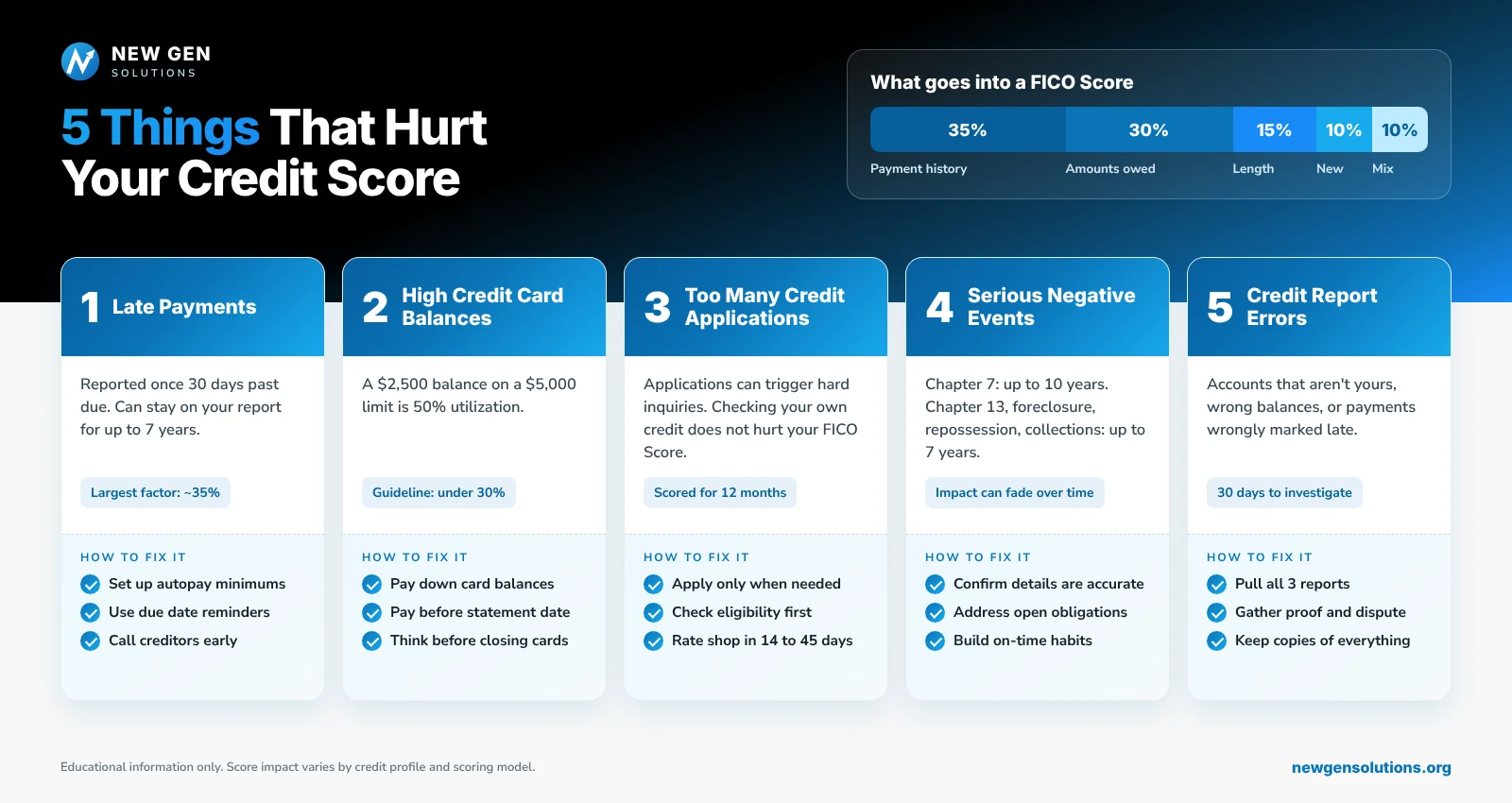
A FICO Score considers five major categories:
These percentages represent a commonly published breakdown of the factors used in a FICO Score calculation. They are not a guaranteed formula for predicting how a particular action will affect your score. The actual impact depends on your overall credit history and the scoring model being used.
If your score has dropped or you are trying to improve your credit, start by understanding the factors that may be working against you.
Here are five common things that can hurt your credit score and practical steps you can take to address them.
1. Late Payments
Payment history is the largest category in the commonly published FICO Score breakdown, accounting for approximately 35% of the calculation.
Even one missed payment can become a problem, particularly if it is reported to the credit bureaus. A payment that is only a few days late may result in a fee, but creditors generally report a payment as delinquent once it reaches 30 days past due.
A reported late payment can remain on your credit report for up to seven years. Its impact may lessen over time, but recent late payments can be particularly damaging.
How to Address Late Payments
Set up automatic payments. Consider enabling automatic minimum payments to help avoid missed due dates. You can still make additional payments manually when possible.
Use payment reminders. Calendar alerts, banking notifications, and budgeting apps can help you stay aware of upcoming due dates.
Contact your creditor. If you are having difficulty making a payment, reach out before the account becomes delinquent. Ask whether payment arrangements or hardship options are available.
Review your credit reports. If a late payment is reported incorrectly, you can dispute the information with the credit bureau and the company that furnished it.
A consistent payment routine can help you avoid preventable late payments and support healthier credit habits.
2. High Credit Card Balances
Your credit utilization refers to how much of your available revolving credit you are using.
For example, if your credit card has a $5,000 limit and you have a $2,500 balance, your utilization on that card is 50%.
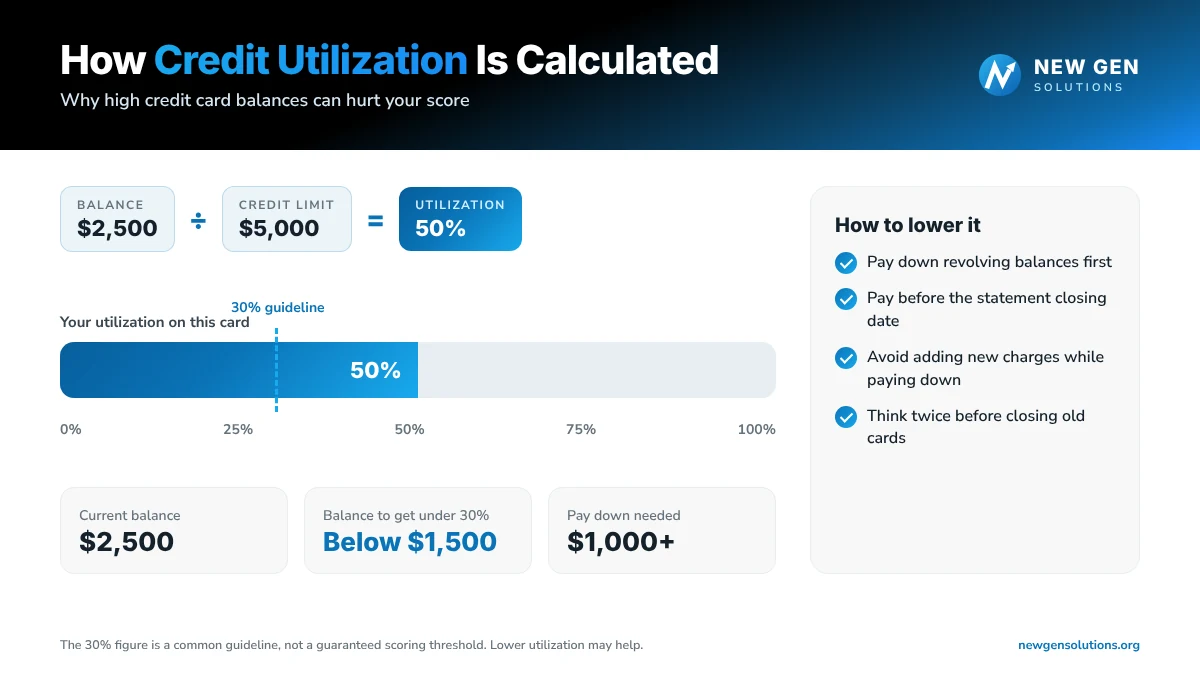
High credit card balances can negatively affect your credit score because amounts owed are an important part of many scoring models.
A commonly used guideline is to keep credit utilization below 30%. However, this is not a universal scoring threshold or a guarantee of a particular score. Lower utilization may be beneficial, depending on your overall credit profile.
How to Address High Credit Card Balances
Pay down revolving balances. Focus on reducing outstanding credit card balances, especially on accounts with high utilization.
Avoid unnecessary purchases. Try not to increase your balances while working toward paying them down.
Understand your statement dates. Credit card issuers often report balances around the statement closing date, although reporting practices vary. Paying down a balance before the reported balance is submitted may help reduce the utilization reflected on your credit report.
Be thoughtful before closing accounts. Closing a credit card can reduce your total available credit and potentially increase your overall utilization. Consider the account's fees, your spending habits, and your broader financial situation before making that decision.
Managing credit card balances is not just about your total debt. It is also about understanding how much of your available credit you are using.
3. Applying for Too Much Credit at Once
Applying for several credit accounts within a short period can affect your credit score.
When you apply for credit, a lender may request a hard inquiry on your credit report. Hard inquiries can have a small negative effect on your score, although the impact varies depending on your credit profile.
Multiple recent applications may also be considered by lenders when evaluating new credit-seeking activity.
Not every inquiry affects your score. Checking your own credit report and other soft inquiries generally do not affect your FICO Score.
How to Address Too Many Credit Applications
Apply only when necessary. Before submitting an application, consider whether you genuinely need the account and whether you are likely to qualify.
Research your options first. Review eligibility requirements and compare available products before applying.
Avoid unnecessary applications. Submitting several applications simply to see which one gets approved can result in multiple hard inquiries.
Understand rate-shopping exceptions. Certain mortgage, auto loan, and student loan inquiries may be grouped together for scoring purposes when they occur within a qualifying shopping period. Depending on the FICO version, this period may be 14 or 45 days.
Hard inquiries generally remain on credit reports for up to two years, although FICO Scores typically consider hard inquiries from the most recent 12 months.
Being selective with credit applications can help you manage unnecessary inquiries while keeping your financial options open.
4. Bankruptcy, Foreclosure, Repossession, and Other Serious Negative Events
Certain serious negative events can remain on your credit report for several years and may affect your ability to qualify for new credit.
These events can include:
▶️ Bankruptcy: Chapter 7 bankruptcy can generally remain on a credit report for up to 10 years. Chapter 13 bankruptcy is generally reported for up to seven years under common credit bureau reporting practices.
▶️ Foreclosure: A foreclosure can generally remain on your credit report for up to seven years.
▶️ Repossession: A repossession can generally remain on your credit report for up to seven years, although the reporting timeline can depend on the underlying account.
▶️ Collections: Collection accounts can generally remain for up to seven years, with the reporting period typically tied to the original delinquency date.
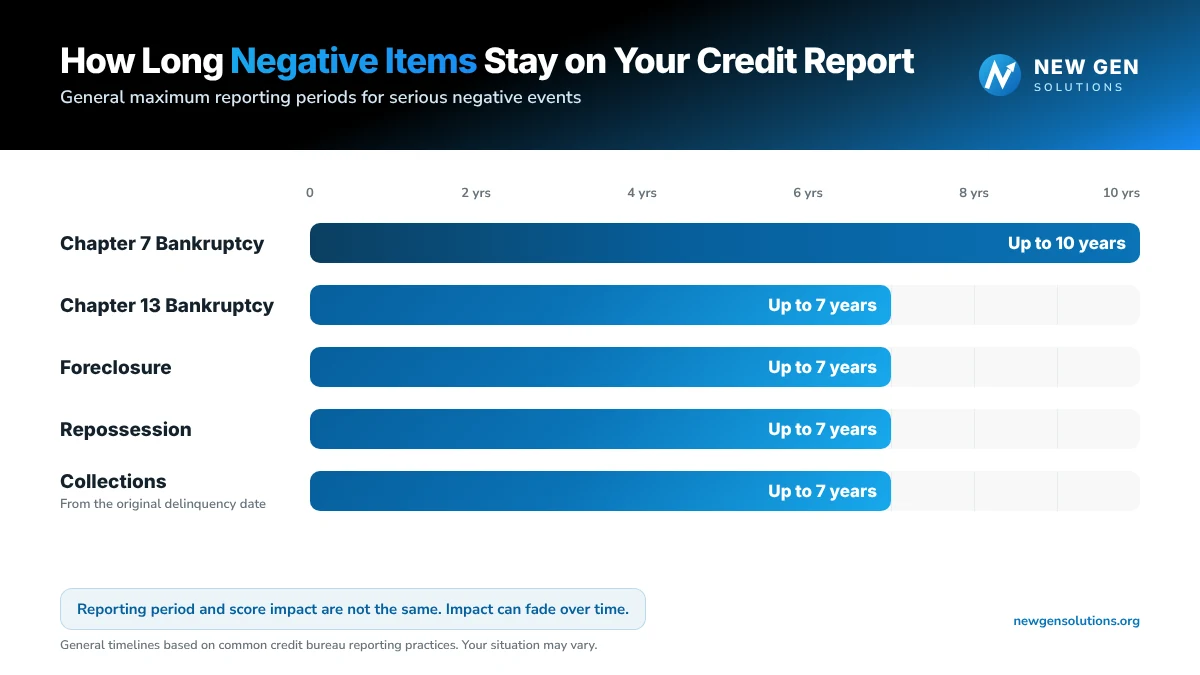
The reporting period and the impact on your score are not necessarily the same thing. A negative item may remain on your report even as its influence on your score changes over time.
Debt settlement is also worth understanding separately. Settling a debt does not automatically erase its payment history or remove the account from your credit report. The way it appears depends on the account's history and how the creditor reports it.
How to Address Serious Negative Events
Review your credit reports. Make sure the information is accurate, including account details, balances, dates, and payment history.
Address outstanding obligations. If you still have unresolved debts, understand your options and consider speaking with a qualified financial or legal professional when appropriate.
Build positive payment habits. Consistently managing current accounts can help establish a healthier credit history over time.
Be cautious of unrealistic promises. No company can guarantee that accurate, current, and verifiable negative information will be removed simply because it is hurting your credit score.
Serious negative events can make rebuilding credit more challenging, but they do not mean you cannot work toward a stronger financial position.
5. Credit Report Errors You Never Dispute
Your credit report contains information about your credit accounts, payment history, balances, and other financial activity.
Unfortunately, mistakes can happen. Incorrect information may appear because of reporting errors, outdated records, identity theft, or accounts that do not belong to you.
Examples of possible credit report errors include:
Inaccurate information can affect how lenders evaluate your credit profile and may influence your credit score.
How to Address Credit Report Errors
Get copies of your credit reports. Visit AnnualCreditReport.com to access your credit reports from Equifax, Experian, and TransUnion.
Review every account carefully. Check account ownership, balances, payment history, account status, and dates.
Identify information that may be inaccurate. Gather supporting documents, such as payment confirmations, account statements, or correspondence from creditors.
Submit a dispute. You can dispute inaccurate or incomplete information directly with the credit bureau reporting it and, when appropriate, with the company that supplied the information.
Keep records of your disputes. Save copies of your submissions, supporting documents, and investigation results.
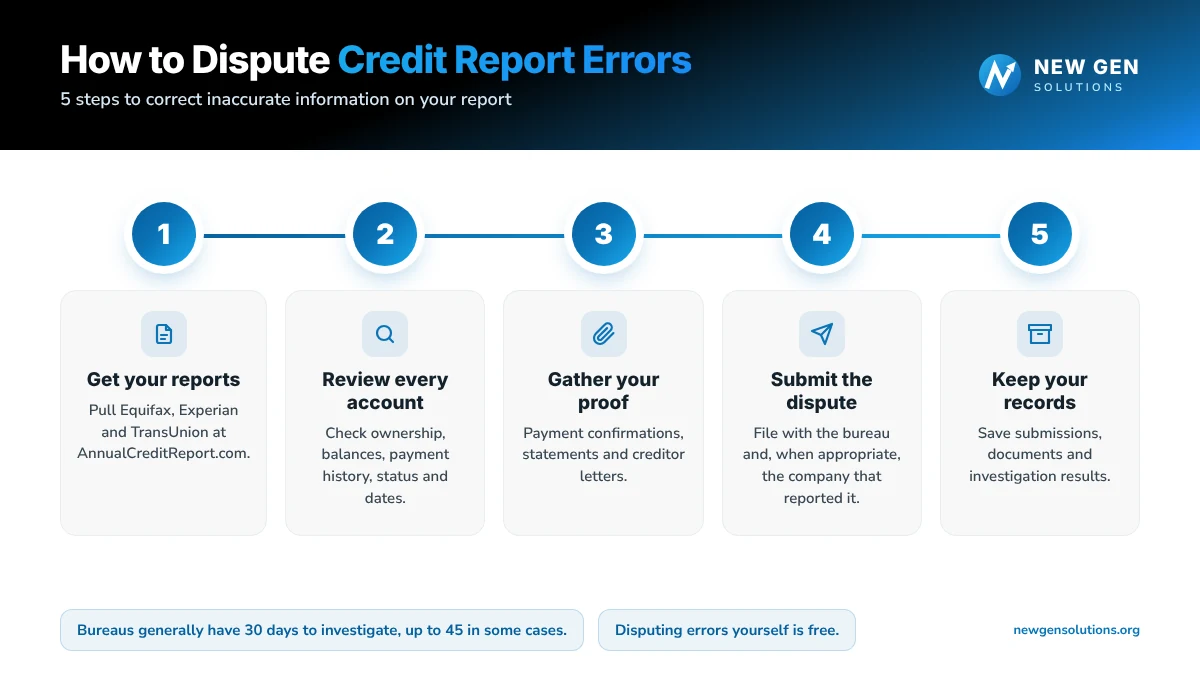
Credit bureaus generally have 30 days to investigate a dispute. In certain circumstances, the investigation period may extend to 45 days.
You do not need to hire a credit repair company to dispute inaccurate information. Consumers have the right to dispute eligible errors themselves at no cost.
Keep in mind that accurate, current, and verifiable information generally cannot be removed simply because it negatively affects your credit score.
If you suspect identity theft, visit IdentityTheft.gov for guidance on reporting and addressing the issue.
What Should You Address First?
If you are working to improve your credit, it helps to prioritize the issues that need attention rather than trying to change everything at once.
Consider this order:
Your priorities may differ depending on your financial situation, account history, and credit goals. Not sure which applies to you? Start with a free consultation.
Building Better Credit Takes Consistency
Improving your credit is not usually a one-time task. It involves understanding your credit reports, managing your accounts responsibly, and developing financial habits that support your long-term goals.
For example, someone with high credit card utilization may benefit from focusing on reducing revolving balances. Someone with an incorrectly reported late payment may need to prioritize reviewing their credit reports and submitting a dispute.
The right approach depends on what is actually affecting your credit profile.
Rather than relying on shortcuts or promises of instant results, focus on understanding your credit and taking informed, consistent steps. For ongoing credit education, join the New Gen Academy.
How New Gen Solutions Can Help
Understanding your credit reports and identifying the factors affecting your credit can feel overwhelming, especially when you are unsure where to start.
New Gen Solutions helps individuals better understand their credit profiles, explore areas that may need attention, and work toward more informed financial decisions.
Our team can help you understand your credit situation and explore service plans based on your needs and goals.
Ready to take a closer look at your credit?
You can also call us at +1 (833) 976-2966 to learn more.